Categories
Cart
0
0
No products
Wait for the notification!
Shipping
0,00$
Total
Product successfully added to your shopping cart
Quantity
Total
There are 0 items in your cart. There is 1 item in your cart.
Total products
Total shipping
Wait for the notification!
Total
Categories
- Works
-
Series
- Gary Goryany
- Sasha Bob
- Petr Yemets
- Kristina Smelova
- Alexey Petrenko
- Anatoliy Marchuk
- Nina Bozhko
- Igor Melnik
- Georgy Ponomarev
- Roman Bonchuk
- Eduard Prykhod
- Tetyana Myalkovska
- Vitaliy Dovgasenko
- Влад. Габда
- Inna Pantelemonova
- Anton Yatsyk
- Taras Pikush
- Andrii Toderiuk
- Iryna Shumeiko
- Степан Федорин
- Mariia Poliakova
- Myron Kataran
- Igor Gnativ
- Inna Mosienko
- Uri Wyslouch & Ivanna Stratiychuk
- Oleksandr Zhyltsov
- Игорь Поляков
- Игорь Осипов
- Мар'яна Мотика
- Andriy Bludov
- Marharyta Zhurunova
- Anastasiia Khudiakova
- Yurii Daskaliuk
- Mykhaylo Gladyuk
- Vasyl Dutka
- Yaroslav Leonets
- Yevheniia Poberezhna
- Roksolana Deineha
- Vasyl Kolodii
- Nazar Ivanyuk
- ViktoriiaKartashova
- Olexiy Dynnyk
- Sofia Konopelkina
- Daniel Kozeletckiy
- Olga Osnach
- Volodymyr Romanov
- Marta Luchynets
- Vadym Lipskykh
- Sofiia Holubeva
- Denys Tymchyshyn
- Bogdan Burak
- Dmitry Dobryanskiy
- Kristina Otchich-Cherniak
- Max Newschoolenko
- Oleksandra Voronina
- Mykhailo Tarasenko
- Mykhaylo Gladyuk
- Nataliia Zinovchuk
- Oleksandra Kryshovska
- Vasyl Petrovskyy
- Volodymyr Glukhomanyuk
- Volodymyr Podlevsky
- Ihor Konovalov
- Evgeniy Shapovalov
- Vlada Ralko
- Mariko Gelman
- Danylo Kovach
- Lina Chanturia
- Oleh Lunov
- Karina Danylchuk
- Oleh Kalashnik
- Oleksandr Bohomaz
- Roman Minin
- Olga Gladushevska
- Kateryna Poltavska
- Maksym Malylo
- Serg Poznansky
- Viktoriya Dubovyk
- Ivan Golmov
- Bagrat Arazyan
- Mykola Dzhychka
- Volodymyr Gabuda
- Viktor Prodanchuk
- Vitaliy Dmytruk
- Lesia Maksymova
- Volodymyr Kostyrko
- Volodymyr Loboda
- Denys Metelin
- Ivanna Orliuk
- Oleksii Revika
- Yurii Yermolenko
- Volodymyr Byzov
- Anastasiia Podervianska
- Alena Kuznetsova
- Oleksandr Povod
- Pavlo Fulei
- Collections
- Style
- Direction
- Genre
- NFT
- Publications
INFORMATION
ARTISTS
- Adelina Braganets
- Adriana Kachmar
- Agata Gerthen
- Albin Gavdzinsky
- Albina Tabaka
- Aleksandar Bonačić
- Aleksey Kulakov
- Alena Kuznetsova
- Alex Rubanov
- Alexander Khvostenko-Khvostov
- Alexander Vygovsky
- Alexandr Nikolayevsky
- Alexandr Onishenko
- Alexey Petrenko
- Alina Evdoschenko
- Alisa Onipchenko-Cherniakovska
- Alla Kasian
- Anastasiia Khudiakova
- Anastasiia Osmolovska
- Anastasiia Podervianska
- Anatolii Furlet
- Anatolii Tertychnyi
- Anatoly Drevetsky
- Anatoly Kryvolap
- Anatoly Marchuk
- Anatoly Petritsky
- Anatoly Tartakovsky
- Anatoly Zorko
- Andrew Serebryakov
- Andrii Davydenko
- Andrii Kulagin
- Andrii Toderiuk
- Andrii Zelinskyi
- Andriy Bludov
- Andriy Kopchak
- Andriy Lipovka
- Andriy Tsoi
- Andriy Dudchenko
- Andriі Kotlіarchuk
- Angela Holodetska
- Angelina Gafynets
- Anna Bashlykova
- Anna Bitaieva
- Anna Mystetska
- Anna Susharnyk
- Anton Yatsyk
- Artem Andreichuk
- Artem Lukianchuk
- Astian Rey
- Attila Kopriva
- Bagrat Arazyan
- Bohdan Burak
- Bohdan Dobrivskyi
- Bohdan Kuziv
- Bohdan Soroka
- BONDERO
- Borys Serdiuk
- Borys Sheremeta
- Daniel Kozeletckiy
- Danylo Kovach
- Darina Mikityuk
- Daryna Beznosenko
- Daryna Olinkevych
- Denys Horodnychyi
- Denys Metelin
- Denys Tymchyshyn
- Dmitro Moldovanov
- Dmitry Dobryanskiy
- Dmytro Kindrat
- Dmytro Kurovsky
- Dmytro Motrii
- Dmytro Trynchuk
- Ed Potapenkov
- Eduard Belsky
- Eduard Prykhodko
- Elena Gavdzinskaya
- Elena Ivaniuk
- Elvira Mamedova
- Eugen Stein
- Eugenia Tynna
- Eva Holts
- Evgeniy Shapovalov
- Evgeniy Tkachenko
- Evgeny Pogorely
- Fedir Zakharov
- Fedor Nirod
- FRIKART
- Gary Goryany
- Gelena Pavlenko
- Georgy Ponomarev
- Geza Gyorke
- Gocha Gulelauri
- Halyna Sorokhan
- Halyna Stelmashchuk
- Hanna Huridova
- Hanna Kozeletska
- Hanna Mihas
- Hans Scheib
- Helen Mount
- HOKO
- Igor Gnativ
- Igor Gusev
- Igor Melnyk
- Igor Panchuk
- Igor Prokofiev
- Ihor Bodnar
- Ihor Hubskyi
- Ihor Kolisnyk
- Ihor Konovalov
- Ihor Mikula
- Ihor Poliakov
- Ihor Volkov-Tkachinsky
- Illya Chichkan
- Inna Andrazhevskaya
- Inna Mosienko
- Inna Pantelemonova
- Inna Vodostavska
- Irina Stolyarova
- Iryna Bratko
- Iryna Murashchyk
- Iryna Shumeiko
- Isaac Rabinovich
- Ivan Golmov
- Ivan Petruk
- Ivan Shyshman
- Ivan Tverdun
- Ivan Vynarchyk
- Ivan Zorenko
- Ivanna Orliuk
- Jaroslav Balandyuh
- Julia Martin
- Kamila Bednarska
- Karina Danylchuk
- Karolina Zaborska
- Kateryna Kopeikina
- Kateryna Ocheredko
- Kateryna Poltavska
- Khrystyna Bagan
- Konstantin Kovgan
- Kosta Morr
- Kostiantyn Cherniavskyi
- Kostiantyn Synytskyi
- Kostya Rohotchenko
- Kristina Otchich-Cherniak
- Kristina Smelova
- Krystyna Sirenko
- Kseniia Kostiuchenko
- Kuzmenko Valeriia
- Larysa Chakir-Uzun
- Larysa Polokhina
- Leonid Maadyr-ool
- Leonora Yakymashchenko
- Lesia Maksymova
- Lesya Ros’
- Lesya Tertyshna
- Lesyuk-Makushin
- Lev Markosian
- Lina Chanturia
- Liu Li
- Lukasz Butowski
- Lyudmila Loboda
- Maksym Malylo
- Maksym Mamsikov
- Mamay
- Marharyta Zhurunova
- Maria Vasylenko
- Mariana Romaniuk
- Mariia Poliakova
- Mariko Gelman
- Marina Shkarupa
- Marina Skugareva
- Mariya Hoyin
- Marta Luchynets
- Maryana Motyka
- Maryna Prus
- MarynaShavyrina-Shkoliar
- Matvii Vaisberh
- Max Newschoolenko
- Maxim Yukhno
- MetaDrion
- Mikhail Bobyshov
- Murt Burner
- Myhaylo Skobalo
- Mykhailo Dmytriv
- Mykhailo Markin
- Mykhailo Tarasenko
- Mykhaylo Gladyuk
- Mykola Ampilohov
- Mykola Dzhychka
- Mykola Hrymaliuk
- Mykola Kuryliuk
- Mykola Lukin
- Mykola Matsenko
- Mykola Sologubov
- Mykola Stupinskyi
- Mykola Yarovyi
- Mykola Zhuravel
- Mykyta Kravtsov
- Myron Kataran
- Nadia Vnukova
- Nata Levitasova
- Natalia Didyk
- Natalia Loza
- Natalia Papirna
- Natalia Zastavna
- Nataliia Kokhal
- Nataliia Korf-Ivaniuk
- Nataliia Zinovchuk
- Nazar Ivanyuk
- Nazar Mudrak
- Nazarii Medvid
- Nikita Dmitrenko
- Nikita Storozhkov
- Nina Bozhko
- Nomeda Ciurlionyte
- ODARKA
- OFCH
- Oksana Ivaniuk
- Oksana Svizhak
- Oleg Pinchuk
- Oleh Kalashnik
- Oleh Korotkevych
- Oleh Lunov
- Oleh Putrashyk
- Oleh Shkoloberda
- Oleh Sydorov
- Oleh Tistol
- Oleksandr Antoniuk
- Oleksandr Balbyshev
- Oleksandr Bohomaz
- Oleksandr Demydenko
- Oleksandr Dobrodii
- Oleksandr Gladkyy
- Oleksandr Khrapachov
- Oleksandr Korol
- Oleksandr Korovai
- Oleksandr Mirosnichenko
- Oleksandr Olkhov
- Oleksandr Povod
- Oleksandr Rojtburd
- Oleksandr Serdiuk
- Oleksandr Yurchenko
- Oleksandr Zhyltsov
- Oleksandra Bilobran
- Oleksandra Kryshovska
- Oleksandra Voronina
- Oleksii Bednoshei
- Oleksii Fedor
- Oleksii Fihol
- Oleksii Ivaniuk
- Oleksii Revika
- Oleksiy Koval
- Olena Hlavenchuk
- Olena Ilyenko
- Olena Klymenko
- Olena Sachenko
- Olena Shevchuk
- Olesia Rybchenko
- Olesia Tkachenko
- Olesya Djuraeva
- Olesya Dzhurayeva
- Olexander Voytovych
- Olexiy Dynnyk
- Olga Gladushevska
- Olga Karpenko
- Olga Osnach
- Olga Prykhodko
- Olga Samar
- Olha Kuzyura
- Opanas Tytenko
- Orest Kuziv
- Ostap Patyk
- Pavlo Fulei
- Pavlo Makedonskyi
- Pavlo Ponomarenko
- Peter Yemets
- Petro Osipov
- Petro Smetana
- Petro Smykovskyi
- Polina Verbytska
- Polina Yanovych
- Prince V.I.P
- Raisa Kobzarenko-Korinyok
- Rasim Seidimov
- Roksolana Deineha
- Roman Bonchuk
- Roman Minin
- Roman Nayden
- Roman Petruk
- Roman Romanyshyn
- Ruslan Tremba
- Ruslana Kliuchko
- Sasha & Illya Chichkan
- Sasha Bob
- Sasha Luneva
- Semen Yarovyi
- Seraphim Charkin
- Serg Poznansky
- Sergei Poliakov
- Sergey Prin
- Sergii Paprotskyi
- Sergii Shkoliar
- Sergii Studzinskyi
- Sergio Kovalov
- Serhii Basok
- Serhii Brylov
- Serhii Dekaliuk
- Serhii Laushkin
- Serhii Surgan
- Serhii Yakutovych
- Serhiy Savchenko
- Serhiy Yareshko
- Sivius Black
- Slawomir Witkowski
- Sofia Konopelkina
- Sofiia Holubeva
- Solomia Kovtun
- Stas Pidlypskyi
- Stepan Budulak
- Stepan Fedoryn
- Stiia
- Svetlana Kirlyk
- Svitlana kyrlyk
- Svitlana Kyrlyk
- Svitlana Starodubtseva
- Tamara Tkach
- Taras Matsiuk
- Taras Pikush
- Tatiana Bruni
- Tatiana Mitaki
- Tetiana An
- Tetiana Dmytrenko
- Tetiana Lytko
- Tetiana Ocheredko
- Tetiana Shuliak
- Tetyana Myalkovska
- Tetyana Yagodkina
- Tuzov Art Group
- Uliana Khokhlova
- Uri Wyslouch & Ivanna Stratiychuk
- Ustym Fedko
- Vadim Grinberg
- Vadym Lipskykh
- Vadym Yudytskyi
- Valentina Vaskialite
- Valentyna Vinnikova
- Valentyne Metyk
- Valeria Trubina
- Valerii Duvirak
- Valerii Kozub
- ValeriX Валерій Бекешко
- Valeriya Tarasenko
- Vasyl Bobita
- Vasyl Dutka
- Vasyl Kadar
- Vasyl Khodakivskyi
- Vasyl Kohutych
- Vasyl Kolodii
- Vasyl Petrovskyy
- Vasyl Savchenko
- Vera Pigulska
- Veronika Cherednychenko
- Viacheslav Snisarenko
- Victor Korinyok
- Victor Sydorenko
- Victor Tkachenko
- Victor Tyblevych
- Viktor Khadzhynov
- Viktor Mishurovskiy
- Viktor Prodanchuk
- Viktoria Taraban
- Viktoriia Kartashova
- Viktoriya Dubovyk
- Vinny Reunov
- Vira Olevska
- Vira Yakymchuk
- Vitalii Kolesnykov
- Vitaliy Dmytruk
- Vitaliy Dovgasenko
- Vitaliy Kotendzhi
- Vitaliy Stolyarov
- Vitaly Krasutskyi
- Vlad. Gabda
- Vlada Ralko
- Vladimir Dmitriev
- Vladyslav Shereshevsky
- Vlodko Kaufman
- Volodymyr Batrakov
- Volodymyr Beliakovych
- Volodymyr Byzov
- Volodymyr Gabuda
- Volodymyr Glukhomanyuk
- Volodymyr Kolesnykov
- Volodymyr Kostyrko
- Volodymyr Loboda
- Volodymyr Mykytenko
- Volodymyr Odrekhivskyi
- Volodymyr Oleshchuk
- Volodymyr Podlevsky
- Volodymyr Romanov
- Volodymyr Sakaliuk
- Volodymyr Sandyuk
- Volodymyr Semchuk
- Volodymyr Stetsula
- Vyacheslav Pereta
- Wojciech Kolacz–Otecki
- Yana Antonova
- Yaroslav Leonets
- Yaroslav Miloserdnyi
- Yaroslav Motyka
- Yelyzaveta Obukhovska
- Yevgen Prymachenko
- Yevhen Klymenko
- Yevheniia Bozhko
- Yevheniia Poberezhna
- Yuliia Chaika
- Yuliia Krashchenko
- Yuri Yurovsky
- Yurii Daskaliuk
- Yurii Honcharenko
- Yurii Pikul
- Yurii Solomko
- Yurii Yermolenko
- Yuriy Koval
- Zenoviy Flinta
- Zlata Shyshman
- Zoriana Garbar
- Zoya Vorotyntseva
- Аlina Khrapchynska
- АРТ
- АРТ-3
- АРТ_2
- Оlexander Lidagovsky
Viewed products
-
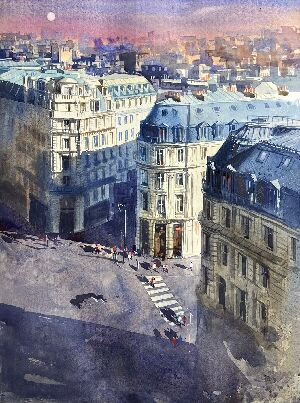
Rhytms of Evening Quaters
Watercolor on paper

Mikhail Dmitrov’s Renaissance
The beginning of Mikhail Dmitrov’s creative path was in the 1970’s of the last century. In the USSR, it was a difficult, sleepy, hypocritical time: the system choked all life, remaining indifferent to the personality of the artist.
Prolonged Debut
It happened that all my first projects were approved by high commissions; they won contests, but under there was no funding for them.
The officials, who gave permission for the installation of sculptural objects, endorsed the work of Dmitrov’s verdict ‘Does not meet the method of socialist realism,’ and therefore has no right to exist.
The graduate work at the Lvov Art School “Entry sign to the City of Gorodok”, was banned for installation, as it was associated with a trident. The sketch of the fountain “Desna flows into the Dnepr” was not approved because they saw forbidden sensuality in it. His graduate project, the monument to Vasily Stefanyk, which managed to be realized, Mikhail Dmitrov put at his own expense.

Mikhail Dmitrov. Monument to Vasily Stefanik. 1979
‘I Wrapped a Child in a Chestnut Leaf’
After graduation, Dmitrov was not allowed to stay in the capital, and for a long time, he could not find a job in his specialty at all. But even in hard times of material difficulties and the absence of state orders, the artist continued to create.
In 1982, Mikhail Dmitrov won the competition to create a commemorative medal “Born in the City-Hero Kiev”. At the heart of the composition, there is a brilliant and at the same time very simple idea.
I wrapped a child in a chestnut leaf and won the contest. This brought a little inspiration and gave material support (the medal was replicated for ten years, and in the capital’s registry offices it was given to all newborns in Kiev).
By the way, during the work on the project, the youngest daughter three-months-old Oksana “posed” for the artist.

Mikhail Dmitrov. Sketch of the medal "Born in the hero-city of Kiev". 1980
“This is My Pain”
Long before Ukraine gained independence, Mikhail Dmitrov turned to the topic of the UIA and people’s deportation from the border areas. Subsequently, he repeatedly returned to these and other tragic pages of the history of Ukraine.
In 1984, the sculpture created “Pieta (Operation Vistula)”. In the1990’s, the “Wounded Angel”, “Victims of the Holodomor”, and “Motovilov Combat” were added to it.

Mikhail Dmitrov. "Pieta (Operation" Vistula ")". 1980.
These are all autobiographical things. My eternal pain.
Among other works of the artist, which marked the 1980’s, it is necessary to highlight the reliefs “Vasily Stefanyk”, “Ivan Franko”, the medal “Kirill Stetsenko”, the project of the monument “Solomia Krushelnytskaya”. The important part of these works, first of all, is the reflection of the polyphonic, contradictory inner world of the heroes. The external resemblance is perceived by the sculptor rather as an indispensable condition of the game, the installation of a realistic style. The amazing similarity is accompanied by the sensuality. The portrait of a friend, the poet Vasily Gerasimyuk, due to the elegance of carving can be compared with the works of masters of antiquity.
Mikhail Dmitrov. Portrait of a friend - the poet Vasily Gerasimyuka. 1980
In the 1990’s, the sculptor, keen on the idea of the emergence of independent Ukraine’s culture, created the reliefs “Olga and Vladimir”, “Ivan Franko and Vasily Zagayevich”, the medal “Mikhail Boychuk”, the project of the monument “Taras Shevchenko”.
The Austrian Period
In 2000, Mikhail Dmitrov accepted the invitation of the St. Margaret Academy and came to Austria. Here, in cooperation with local masters, he works on the restoration of ancient Austrian sculpture, and the revival of folk traditions. Improvisator and analyst, he boldly and confidently experiments with form, styles and techniques, perfects his skills. Studying the European experience, he puts it through the prism of his own authorial experience both aesthetic and spiritual, creating a new quality and making his own discoveries.
The works of this period have mostly predominantly religious and philosophical sense (“Saint Florian”, “Khritofor Holiday”, “Mary Magdalene”, “Mother of God”, etc.). They are associated with the appeal to the Christian tradition, the Bible, are based on the main Christian-worldview categories: faith, happiness, and love.
The sculpture “Father Pio” was installed in the Austrian town of Ollendorf in 2003. The statue depicts an Italian monk from the Capuchin order Padre Pio of Pietrelcin, canonized in 2002. It organically combines the sacred content and realistic image of the monk. His figure remains calm, noble and at the same time possesses a magical power: with a confident, blessing gesture the saint gives hope and healing to everyone who asks for help.
But being multifaceted, the sculptor is not limited only to religious topics. In Austria, Dmitrov arranges solo exhibitions, he works to order. At the request of the organizers of the international music contest dedicated to the memory of Frank Sinatra, Dmitrov creates the main prize, a medal to the winner. The round stone reward of a meter diameter amazed by the skill it was made with, the sense of form, the imagery of thinking, and elegant humor.
More than 600 sculptural compositions of the Ukrainian artist, created during this period, enriched private collections and decorated the interiors of Austria, Germany, and America.
Architecture and Design
In 2006, Mikhail Dmitrov returned to Ukraine and plunged into a new hobby, architecture and landscape design. The experience gained during his studies in Austria was successfully implemented by him, creating estates projects. Dmitrov’s design works are marked by a harmonious combination of natural and artificial forms, man-made structures and ornamental plant groups. Each manor has its own expressive silhouette, flavor, which makes it differ from the others.
Carrying out an order for the decoration of restaurants, cafes Dmitrov demonstrates another facet of his talent: he is a brilliant decorator. In his interiors, one can read both a sense of material (whether it is wood, ceramics, bronze, marble, wax, glass, mirror or even water) and love of the texture game. Polychrome and harmony of contrasts, original composition, dynamics and perfection of forms, present in all of his design decisions, give the rooms a special atmosphere. But the main distinguishing feature of Dmitrov’s projects lies in the fact that they retain a single style: European, but deeply national, having folk roots and developing the Ukrainian artistic tradition.
I used to work with Japanese, French, and Austrian designers and architects; I saw different styles and directions, but I always return to our archaic Ukrainian mud hut. Clay, wood, stone are a healthy environment in which you can bring up strong and intelligent children.
Dmitrov’s characteristic feature is especially expressive in the projects of historical and architectural ensembles’ restoration: the estate of the Khanenko* family in the village of Olenevka, the settlement “Melnitsa” on the Fastovschina, the ancient settlement and the castle in Makarov.
For the project of the chapel in the settlement “Melnitsa”, the sculptor was awarded the diploma of the Patriarch of Kyiv Philaret. In the silhouettes of the stone structure’s dome, the helmets of ancient Slav warriors facing the four directions of the world are traced. The bright dome of the rotunda looks especially impressive against the blue sky, a kind of symbol of purity, spirituality, and faith. Here everything resembles an earthly paradise, gives the heart a special peace. The theme of the divine as the supreme law of truth and grace unites all the works of the author, being the embodiment of his cultural ideals.
Developing Traditions, Reflecting Times
The creativity of Mikhail Dmitrov is a modern Ukrainian Renaissance, the preservation, and continuation of those important features of cultural heritage that will pass from ancestors to descendants, after all, according to the sculptor’s deep conviction, the revival of the state occurs through the revival of culture.
Mikhail Dmitrov. "From the creation of the world." 2010
Dmitrov, of course, is the bearer of realistic traditions in art. At the same time, his works are symbolic and modern: it is an art with which you can contact, communicate, realizing that it is a reflection of the time in which you live today. Through symbols and images, the sculptor shares his view of the past and the present with his viewer, his view of art is like a vision of a path to intellectual and emotional improvement of a person. One of the creative plans of the artist is to create the Ukrainian Stonehenge, a kind of altar of national history: Baturin, Kruty, UIA, Babiy Yar, Heavenly Hundred.
Leave a comment
Related posts
-
 Alexander Vygovsky’s Unformat
"When I was ten, I played football. When he was twenty, he studied at the university to become an engineer. When he...
Alexander Vygovsky’s Unformat
"When I was ten, I played football. When he was twenty, he studied at the university to become an engineer. When he... -
In Search of Lost Dreams
In the paintings of Goryany, we observe an alchemical process, as a result of which cosmic energy, concentrated in...
-
Blue Blush by Sasha Bob
The first thing that catches your eye is the apparent simplicity, deliberate negligence and that extraordinary...
-
Song of Protest by Peter Yemts
In the late 1980’s, journalists called Petr Yemets a stalker of the Chernobyl zone, a guide who leads people to an...
-
Any Painting is a Drawing of Yourself
In Kristina Smelova’s painting, the impressionist methods are clearly visible. Working mostly with the palette knife,...
Latest comments