Categories
Cart
0
0
No products
Wait for the notification!
Shipping
0,00$
Total
Product successfully added to your shopping cart
Quantity
Total
There are 0 items in your cart. There is 1 item in your cart.
Total products
Total shipping
Wait for the notification!
Total
Categories
- Works
-
Series
- Gary Goryany
- Sasha Bob
- Petr Yemets
- Kristina Smelova
- Alexey Petrenko
- Anatoliy Marchuk
- Nina Bozhko
- Igor Melnik
- Georgy Ponomarev
- Roman Bonchuk
- Eduard Prykhod
- Tetyana Myalkovska
- Vitaliy Dovgasenko
- Влад. Габда
- Inna Pantelemonova
- Anton Yatsyk
- Taras Pikush
- Andrii Toderiuk
- Iryna Shumeiko
- Степан Федорин
- Mariia Poliakova
- Myron Kataran
- Igor Gnativ
- Inna Mosienko
- Uri Wyslouch & Ivanna Stratiychuk
- Oleksandr Zhyltsov
- Игорь Поляков
- Игорь Осипов
- Мар'яна Мотика
- Andriy Bludov
- Marharyta Zhurunova
- Anastasiia Khudiakova
- Yurii Daskaliuk
- Mykhaylo Gladyuk
- Vasyl Dutka
- Yaroslav Leonets
- Yevheniia Poberezhna
- Roksolana Deineha
- Vasyl Kolodii
- Nazar Ivanyuk
- ViktoriiaKartashova
- Olexiy Dynnyk
- Sofia Konopelkina
- Daniel Kozeletckiy
- Olga Osnach
- Volodymyr Romanov
- Marta Luchynets
- Vadym Lipskykh
- Sofiia Holubeva
- Denys Tymchyshyn
- Bogdan Burak
- Dmitry Dobryanskiy
- Kristina Otchich-Cherniak
- Max Newschoolenko
- Oleksandra Voronina
- Mykhailo Tarasenko
- Mykhaylo Gladyuk
- Nataliia Zinovchuk
- Oleksandra Kryshovska
- Vasyl Petrovskyy
- Volodymyr Glukhomanyuk
- Volodymyr Podlevsky
- Ihor Konovalov
- Evgeniy Shapovalov
- Vlada Ralko
- Mariko Gelman
- Danylo Kovach
- Lina Chanturia
- Oleh Lunov
- Karina Danylchuk
- Oleh Kalashnik
- Oleksandr Bohomaz
- Roman Minin
- Olga Gladushevska
- Kateryna Poltavska
- Maksym Malylo
- Serg Poznansky
- Viktoriya Dubovyk
- Ivan Golmov
- Bagrat Arazyan
- Mykola Dzhychka
- Volodymyr Gabuda
- Viktor Prodanchuk
- Vitaliy Dmytruk
- Lesia Maksymova
- Volodymyr Kostyrko
- Volodymyr Loboda
- Denys Metelin
- Ivanna Orliuk
- Oleksii Revika
- Yurii Yermolenko
- Volodymyr Byzov
- Anastasiia Podervianska
- Alena Kuznetsova
- Oleksandr Povod
- Pavlo Fulei
- Collections
- Style
- Direction
- Genre
- NFT
- Publications
INFORMATION
ARTISTS
- Adelina Braganets
- Adriana Kachmar
- Agata Gerthen
- Albin Gavdzinsky
- Albina Tabaka
- Aleksandar Bonačić
- Aleksey Kulakov
- Alena Kuznetsova
- Alex Rubanov
- Alexander Khvostenko-Khvostov
- Alexander Vygovsky
- Alexandr Nikolayevsky
- Alexandr Onishenko
- Alexey Petrenko
- Alina Evdoschenko
- Alisa Onipchenko-Cherniakovska
- Alla Kasian
- Anastasiia Khudiakova
- Anastasiia Osmolovska
- Anastasiia Podervianska
- Anatolii Furlet
- Anatolii Tertychnyi
- Anatoly Drevetsky
- Anatoly Kryvolap
- Anatoly Marchuk
- Anatoly Petritsky
- Anatoly Tartakovsky
- Anatoly Zorko
- Andrew Serebryakov
- Andrii Davydenko
- Andrii Kulagin
- Andrii Toderiuk
- Andrii Zelinskyi
- Andriy Bludov
- Andriy Kopchak
- Andriy Lipovka
- Andriy Tsoi
- Andriy Dudchenko
- Andriі Kotlіarchuk
- Angela Holodetska
- Angelina Gafynets
- Anna Bashlykova
- Anna Bitaieva
- Anna Mystetska
- Anna Susharnyk
- Anton Yatsyk
- Artem Andreichuk
- Artem Lukianchuk
- Astian Rey
- Attila Kopriva
- Bagrat Arazyan
- Bohdan Burak
- Bohdan Dobrivskyi
- Bohdan Kuziv
- Bohdan Soroka
- BONDERO
- Borys Serdiuk
- Borys Sheremeta
- Daniel Kozeletckiy
- Danylo Kovach
- Darina Mikityuk
- Daryna Beznosenko
- Daryna Olinkevych
- Denys Horodnychyi
- Denys Metelin
- Denys Tymchyshyn
- Dmitro Moldovanov
- Dmitry Dobryanskiy
- Dmytro Kindrat
- Dmytro Kurovsky
- Dmytro Motrii
- Dmytro Trynchuk
- Ed Potapenkov
- Eduard Belsky
- Eduard Prykhodko
- Elena Gavdzinskaya
- Elena Ivaniuk
- Elvira Mamedova
- Eugen Stein
- Eugenia Tynna
- Eva Holts
- Evgeniy Shapovalov
- Evgeniy Tkachenko
- Evgeny Pogorely
- Fedir Zakharov
- Fedor Nirod
- FRIKART
- Gary Goryany
- Gelena Pavlenko
- Georgy Ponomarev
- Geza Gyorke
- Gocha Gulelauri
- Halyna Sorokhan
- Halyna Stelmashchuk
- Hanna Huridova
- Hanna Kozeletska
- Hanna Mihas
- Hans Scheib
- Helen Mount
- HOKO
- Igor Gnativ
- Igor Gusev
- Igor Melnyk
- Igor Panchuk
- Igor Prokofiev
- Ihor Bodnar
- Ihor Hubskyi
- Ihor Kolisnyk
- Ihor Konovalov
- Ihor Mikula
- Ihor Poliakov
- Ihor Volkov-Tkachinsky
- Illya Chichkan
- Inna Andrazhevskaya
- Inna Mosienko
- Inna Pantelemonova
- Inna Vodostavska
- Irina Stolyarova
- Iryna Bratko
- Iryna Murashchyk
- Iryna Shumeiko
- Isaac Rabinovich
- Ivan Golmov
- Ivan Petruk
- Ivan Shyshman
- Ivan Tverdun
- Ivan Vynarchyk
- Ivan Zorenko
- Ivanna Orliuk
- Jaroslav Balandyuh
- Julia Martin
- Kamila Bednarska
- Karina Danylchuk
- Karolina Zaborska
- Kateryna Kopeikina
- Kateryna Ocheredko
- Kateryna Poltavska
- Khrystyna Bagan
- Konstantin Kovgan
- Kosta Morr
- Kostiantyn Cherniavskyi
- Kostiantyn Synytskyi
- Kostya Rohotchenko
- Kristina Otchich-Cherniak
- Kristina Smelova
- Krystyna Sirenko
- Kseniia Kostiuchenko
- Kuzmenko Valeriia
- Larysa Chakir-Uzun
- Larysa Polokhina
- Leonid Maadyr-ool
- Leonora Yakymashchenko
- Lesia Maksymova
- Lesya Ros’
- Lesya Tertyshna
- Lesyuk-Makushin
- Lev Markosian
- Lina Chanturia
- Liu Li
- Lukasz Butowski
- Lyudmila Loboda
- Maksym Malylo
- Maksym Mamsikov
- Mamay
- Marharyta Zhurunova
- Maria Vasylenko
- Mariana Romaniuk
- Mariia Poliakova
- Mariko Gelman
- Marina Shkarupa
- Marina Skugareva
- Mariya Hoyin
- Marta Luchynets
- Maryana Motyka
- Maryna Prus
- MarynaShavyrina-Shkoliar
- Matvii Vaisberh
- Max Newschoolenko
- Maxim Yukhno
- MetaDrion
- Mikhail Bobyshov
- Murt Burner
- Myhaylo Skobalo
- Mykhailo Dmytriv
- Mykhailo Markin
- Mykhailo Tarasenko
- Mykhaylo Gladyuk
- Mykola Ampilohov
- Mykola Dzhychka
- Mykola Hrymaliuk
- Mykola Kuryliuk
- Mykola Lukin
- Mykola Matsenko
- Mykola Sologubov
- Mykola Stupinskyi
- Mykola Yarovyi
- Mykola Zhuravel
- Mykyta Kravtsov
- Myron Kataran
- Nadia Vnukova
- Nata Levitasova
- Natalia Didyk
- Natalia Loza
- Natalia Papirna
- Natalia Zastavna
- Nataliia Kokhal
- Nataliia Korf-Ivaniuk
- Nataliia Zinovchuk
- Nazar Ivanyuk
- Nazar Mudrak
- Nazarii Medvid
- Nikita Dmitrenko
- Nikita Storozhkov
- Nina Bozhko
- Nomeda Ciurlionyte
- ODARKA
- OFCH
- Oksana Ivaniuk
- Oksana Svizhak
- Oleg Pinchuk
- Oleh Kalashnik
- Oleh Korotkevych
- Oleh Lunov
- Oleh Putrashyk
- Oleh Shkoloberda
- Oleh Sydorov
- Oleh Tistol
- Oleksandr Antoniuk
- Oleksandr Balbyshev
- Oleksandr Bohomaz
- Oleksandr Demydenko
- Oleksandr Dobrodii
- Oleksandr Gladkyy
- Oleksandr Khrapachov
- Oleksandr Korol
- Oleksandr Korovai
- Oleksandr Mirosnichenko
- Oleksandr Olkhov
- Oleksandr Povod
- Oleksandr Rojtburd
- Oleksandr Serdiuk
- Oleksandr Yurchenko
- Oleksandr Zhyltsov
- Oleksandra Bilobran
- Oleksandra Kryshovska
- Oleksandra Voronina
- Oleksii Bednoshei
- Oleksii Fedor
- Oleksii Fihol
- Oleksii Ivaniuk
- Oleksii Revika
- Oleksiy Koval
- Olena Hlavenchuk
- Olena Ilyenko
- Olena Klymenko
- Olena Sachenko
- Olena Shevchuk
- Olesia Rybchenko
- Olesia Tkachenko
- Olesya Djuraeva
- Olesya Dzhurayeva
- Olexander Voytovych
- Olexiy Dynnyk
- Olga Gladushevska
- Olga Karpenko
- Olga Osnach
- Olga Prykhodko
- Olga Samar
- Olha Kuzyura
- Opanas Tytenko
- Orest Kuziv
- Ostap Patyk
- Pavlo Fulei
- Pavlo Makedonskyi
- Pavlo Ponomarenko
- Peter Yemets
- Petro Osipov
- Petro Smetana
- Petro Smykovskyi
- Polina Verbytska
- Polina Yanovych
- Prince V.I.P
- Raisa Kobzarenko-Korinyok
- Rasim Seidimov
- Roksolana Deineha
- Roman Bonchuk
- Roman Minin
- Roman Nayden
- Roman Petruk
- Roman Romanyshyn
- Ruslan Tremba
- Ruslana Kliuchko
- Sasha & Illya Chichkan
- Sasha Bob
- Sasha Luneva
- Semen Yarovyi
- Seraphim Charkin
- Serg Poznansky
- Sergei Poliakov
- Sergey Prin
- Sergii Paprotskyi
- Sergii Shkoliar
- Sergii Studzinskyi
- Sergio Kovalov
- Serhii Basok
- Serhii Brylov
- Serhii Dekaliuk
- Serhii Laushkin
- Serhii Surgan
- Serhii Yakutovych
- Serhiy Savchenko
- Serhiy Yareshko
- Sivius Black
- Slawomir Witkowski
- Sofia Konopelkina
- Sofiia Holubeva
- Solomia Kovtun
- Stas Pidlypskyi
- Stepan Budulak
- Stepan Fedoryn
- Stiia
- Svetlana Kirlyk
- Svitlana kyrlyk
- Svitlana Kyrlyk
- Svitlana Starodubtseva
- Tamara Tkach
- Taras Matsiuk
- Taras Pikush
- Tatiana Bruni
- Tatiana Mitaki
- Tetiana An
- Tetiana Dmytrenko
- Tetiana Lytko
- Tetiana Ocheredko
- Tetiana Shuliak
- Tetyana Myalkovska
- Tetyana Yagodkina
- Tuzov Art Group
- Uliana Khokhlova
- Uri Wyslouch & Ivanna Stratiychuk
- Ustym Fedko
- Vadim Grinberg
- Vadym Lipskykh
- Vadym Yudytskyi
- Valentina Vaskialite
- Valentyna Vinnikova
- Valentyne Metyk
- Valeria Trubina
- Valerii Duvirak
- Valerii Kozub
- ValeriX Валерій Бекешко
- Valeriya Tarasenko
- Vasyl Bobita
- Vasyl Dutka
- Vasyl Kadar
- Vasyl Khodakivskyi
- Vasyl Kohutych
- Vasyl Kolodii
- Vasyl Petrovskyy
- Vasyl Savchenko
- Vera Pigulska
- Veronika Cherednychenko
- Viacheslav Snisarenko
- Victor Korinyok
- Victor Sydorenko
- Victor Tkachenko
- Victor Tyblevych
- Viktor Khadzhynov
- Viktor Mishurovskiy
- Viktor Prodanchuk
- Viktoria Taraban
- Viktoriia Kartashova
- Viktoriya Dubovyk
- Vinny Reunov
- Vira Olevska
- Vira Yakymchuk
- Vitalii Kolesnykov
- Vitaliy Dmytruk
- Vitaliy Dovgasenko
- Vitaliy Kotendzhi
- Vitaliy Stolyarov
- Vitaly Krasutskyi
- Vlad. Gabda
- Vlada Ralko
- Vladimir Dmitriev
- Vladyslav Shereshevsky
- Vlodko Kaufman
- Volodymyr Batrakov
- Volodymyr Beliakovych
- Volodymyr Byzov
- Volodymyr Gabuda
- Volodymyr Glukhomanyuk
- Volodymyr Kolesnykov
- Volodymyr Kostyrko
- Volodymyr Loboda
- Volodymyr Mykytenko
- Volodymyr Odrekhivskyi
- Volodymyr Oleshchuk
- Volodymyr Podlevsky
- Volodymyr Romanov
- Volodymyr Sakaliuk
- Volodymyr Sandyuk
- Volodymyr Semchuk
- Volodymyr Stetsula
- Vyacheslav Pereta
- Wojciech Kolacz–Otecki
- Yana Antonova
- Yaroslav Leonets
- Yaroslav Miloserdnyi
- Yaroslav Motyka
- Yelyzaveta Obukhovska
- Yevgen Prymachenko
- Yevhen Klymenko
- Yevheniia Bozhko
- Yevheniia Poberezhna
- Yuliia Chaika
- Yuliia Krashchenko
- Yuri Yurovsky
- Yurii Daskaliuk
- Yurii Honcharenko
- Yurii Pikul
- Yurii Solomko
- Yurii Yermolenko
- Yuriy Koval
- Zenoviy Flinta
- Zlata Shyshman
- Zoriana Garbar
- Zoya Vorotyntseva
- Аlina Khrapchynska
- АРТ
- АРТ-3
- АРТ_2
- Оlexander Lidagovsky
Viewed products
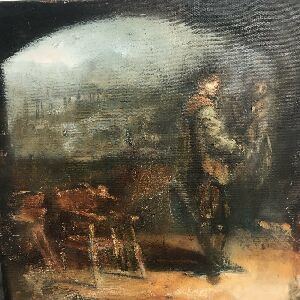

Blue Blush by Sasha Bob
The limit of dullness is to draw an apple as it is.
Salvador Dali
Without seeing his paintings, but only reading the names: “Madonna and Child”, “Apostle”, “Danila Galitsky”, “Alexander the Great”, “Napoleon” - you can imagine anything, but not what is really shown on these canvases.
The first thing that catches your eye is the apparent simplicity, deliberate negligence and that extraordinary freedom which the artist uses to paint his images. At first glance, there is a feeling that I would also be able to do this. But trying to understand why this or that work attracted you so much, you begin to understand the whole incomprehensibility of this simplicity. Probably the whole thing is in the colour scheme. Often it seems crazy, but for some reason, very close and understandable.

These paintings are impossible to watch casually. You must immerse yourself in each of them. To stop abstracting yourself from the outside world and your own ideas about it; plunge into the ratio of shapes and colours that the artist offers us. 
Being an extraordinary colourist, Sasha Bob combines different colours in often completely unexpected combinations: pink road, yellow sky, grey air, red city. At the same time, it seems that he blurs the surrounding space in order to focus the viewer's attention on the main character, and most often this is the image of a person.
"Boards"
In 2016, Sasha created a series of paintings on hardboard, which he assigned the working name “Boards”. For convenience, we will keep that name. This is a large series of abstract, rather distant, landscapes with human silhouettes in the foreground and unchanged mills in the middle or background. 
In these works, the author surprisingly managed to recreate a special spatial system that meets all the rules of perspective, but at the same time overturns the usual view of the natural environment. He is kind of inspired by this environment, but he does not seek to reproduce it in a realistic manner. And there is an amazing thing: without painting nature directly, he affirms its greatness and beauty in his works. 
It is interesting that by the colour scheme it is possible to determine with almost one hundred percent accuracy the time of year when the picture was painted. Gray, gloomy tones, this is winter; saturated pink paint appeared, it means spring has come, and picture No. 59, sparkling with warm yellow, was painted exactly on December 31, it seemed to absorb the taste and smell of ripe, juicy oranges.

The dense airspace is compressed to such a density that it seems that we can touch it with all our senses: touch with our fingers, try with our lips, inhale with our nose. But at the same time there is an incomprehensible illusion of weightlessness and going deep.

Ghost people, mirage people move in a phantasmagoric universe. Their silhouettes seem transparent, as if they let the environment through them, but nowhere they merge with it completely. There are no faces to be seen, we see only the backs. And the footprints. Or shadows - orange, red, gray... 
In some paintings there are numbers - 1, 2, 3, 4, 5, symbolizing the transience of human life; and there are mills almost everywhere as a symbol of cyclicality: everything that is vanity will be crushed in the eternal cycle of being and only the important thing will remain, which will be repeated endlessly.

Facing the viewer
In 2017, Sasha Bob again changes his style radically: from hardboard he returns to canvases, uses more vivid colours, but most importantly, he turns all his characters 180 degrees, that is, facing the viewer. Or paints them in sideview. They are no longer impersonal symbols, but specific characters - a pirate, a samurai, a Viking. Cinematic (book) characters are adjacent to specific historical figures - Julius Caesar, Napoleon, Danila Galitsky, Alexander the Great. I wanted to write: “They look at us from the artist’s paintings”, but no, they don’t care about us. Yes, some have no eyes.


In order to cut off everything unnecessary, Sasha continues to deliberately simplify everything that is possible. Although we recognize some characters at once (for example, “The Godfather” of don Vito Corleone, or rather, the actor who played him, Marlon Brando), as a rule, our attention does not focus on faces, often there are practically none.
“I like to portray both kings and robbers, but these are not copied images from portraits of others, but a generalized image of power, romance, adventurism, etc.”

The figures are painted conditionally and deliberately ineptly. There are only a few basic colours: blue, red, black, blue, black, yellow. But such a decision is dictated by nothing more than the desire to create a solid constructive foundation in each picture, to achieve its ambiguity. And the artist succeeds.
Sacred
His apostles and Madonnas seemed to have passed through the centuries, and time did not spare them, having touched the ceiling, smudges and cracked paint.

No, these are not icons. The paintings, created in the personal manner of the author, do not carry a deep religious concentration, but there is an amazing thing: these images are quite perfect in their spirituality. And how accurately the artist conveys the essence of each image.

In "Apostle Peter" all proportions are intentionally broken, the emphasis is only on the eyes. The closest disciple of Christ, he is not attached to anything mundane, to any object or living being, all of his attachments are connected with God. Another thing is the Madonna, holding her baby in her arms, her whole world is concentrated on him.
“For me, this is absolutely not a religious symbol, but the designation of the greatest harmony: mother and her child, the foundation of human existence. Therefore, I filled it in the form of an old fresco, thus denoting enduring values. But this is a completely modern image. ”

The following two paintings - “George the Victorious” and the second “Madonna” are interesting primarily because both are made using a lot of red, but this color plays so differently! In the first work, he creates the illusion of movement and brings powerful energy to the image of St. George. The red dress of the Madonna adds some calmness to the image. However, this is not a boring and indifferent reassurance, but a feeling that leads us to some excitement, which attracts and causes subtle anxiety.

“Beautiful people are uninteresting”
The artist is not shy of the genre picture as well - everyday scenes in which our contemporaries participate. Life and the whole gamut of human feelings are conveyed in small, everyday things.
Each picture is a separate momentary relevance. The author identifies topics that occupy him at a particular moment of time: a carefree, joyful girl on the seashore; father and son with a paper airplane in their hands; two people with glasses of invigorating drink; a boy and a girl who went out for a walk. Everyday situations. But for some reason, again, there is not a single beautiful face…
“I don’t know which artist might like a beautiful person. This is not interesting for me. We need some kind of defect: ears, nose, hairstyle, something that you can catch on.”
And how artistically, with precise lines, the artist depicts the expressive poses of his characters: the girl, with all her childish directness, covered her knees with her palms; father puts his hand on his son’s shoulder. A young man and a fragile, very small girl compared to him, are just standing, but so excitingly close to each other... No extra details, just the quintessence of emotion. Its essence. And nothing more.

Men's games
Pirates in red tunics and black hats, merciless gansters from the detectives of Chase and noble ones from the novel by Mario Puzo, heroes of Jules Verne and Stephen King, in short, adventurers, gentlemen of luck, people living their life the way they want. This also includes the Western-style series - Indians, cowboys and other characters with a revolver in their hands, inhabiting the Wild West. With rare exceptions, Sasha shows them abstractedly, creating a general romantic mood.
“Probably all of this is an unfinished childhood. I remember when I was a boy, I was watching films about Indiana Jones or the treasure hunters. And now, in adulthood, these images catch up with me, pop up somewhere from the subcortex. ”

Another male topic is related to horses.
“In many nations, a horse represents the masculine, strength and endurance. And in our history, for a long period of time, a horse was an integral part of a man’s life, therefore a rider or a person next to a horse is often present in my paintings.”

A centurion, circling at dawn with the army prepared for battle; Roman Praetorian in Imperial Purple; Alexander the Great himself, rejoicing in the Mesopotamian sands after a stunning victory over Darius. In addition to the legendary Roman warriors, the artist often goes to Greek mythology. Physical strength and fortitude are sung in the canvases "Hercules Tames the Cretan Bull", "The Struggle of Achilles with Hector" and others.

The theme of the male code of honor is also close to the artist. One of the paintings depicts a samurai prepared to carry out a ritual suicide. A calm, even solemn image of a man demonstrating his courage in the face of pain and death. The decision has been made and will be implemented now.

Masculinity as a quality of personality, and courage, as its main feature, manifested in moral firmness and will - this is the very nature of men, the artist believes. After all, the “Bulls” also have physical power, but unlike their owner, even the strongest and most ferocious bull remains a bonded, stalled creature.
Nomad as a state of mind
Among the many diverse works, the paintings, where Sasha Bob portrayed himself can be identified. But it is useless to look for external resemblance - these are not self-portraits in the mirror, but personal experiences of the author embodied in the images, self-portraits of his state, which become a mirror by themselves. There are deformed proportions, unexpected colours and the general allegorical nature of the image typical for Sasha Bob.
One of these works is called “Fiasco”. Made in one breath, it conveys the mood of the author in a moment of despair. Defeat, resentment and sorrow, loss and disappointment look this way ... This is one of the saddest and quietest paintings of the artist.
Sasha's nomads are a bit apart. This may be a lone wanderer in the “Access Zone”, or a cowboy in “Nomad 2”.

“But the cows have nothing to do with it. This is the image of a wanderer, personifying the search within. At one of the plein airs, psychologists worked with us. They asked: “Whom can you feel yourself like an artist?” I was thinking a lot about it. And finally I realized - I am a nomad within myself. I, like that wanderer, looking for a better place to live, wander in painting in order to find for myself the best colour, best shape, image.”
Yes, at first glance it may seem that he writes his work without straining: turning off his brain and giving free rein to his hands. But it does not work this way, because the creator artist is an endless search, analysis, daily emotional surge on the verge, at the limit, as a result of which a new image appears. And not a single picture in the world can be like yours. Because others can’t think like you. And it is impossible to feel another time, as it is today.

Leave a comment
Related posts
-
 Alexander Vygovsky’s Unformat
"When I was ten, I played football. When he was twenty, he studied at the university to become an engineer. When he...
Alexander Vygovsky’s Unformat
"When I was ten, I played football. When he was twenty, he studied at the university to become an engineer. When he... -
In Search of Lost Dreams
In the paintings of Goryany, we observe an alchemical process, as a result of which cosmic energy, concentrated in...
-
Song of Protest by Peter Yemts
In the late 1980’s, journalists called Petr Yemets a stalker of the Chernobyl zone, a guide who leads people to an...
-
Any Painting is a Drawing of Yourself
In Kristina Smelova’s painting, the impressionist methods are clearly visible. Working mostly with the palette knife,...
-
DAEDALUS AND DEMONS
«Мир кажется вращающимся кубиком, и все возвращается в него снова и снова; человек превращается в ангела, а ангел в...
Latest comments