Categories
Cart
0
0
No products
Wait for the notification!
Shipping
0,00$
Total
Product successfully added to your shopping cart
Quantity
Total
There are 0 items in your cart. There is 1 item in your cart.
Total products
Total shipping
Wait for the notification!
Total
Categories
- Works
-
Series
- Gary Goryany
- Sasha Bob
- Petr Yemets
- Kristina Smelova
- Alexey Petrenko
- Anatoliy Marchuk
- Nina Bozhko
- Igor Melnik
- Georgy Ponomarev
- Roman Bonchuk
- Eduard Prykhod
- Tetyana Myalkovska
- Vitaliy Dovgasenko
- Влад. Габда
- Inna Pantelemonova
- Anton Yatsyk
- Taras Pikush
- Andrii Toderiuk
- Iryna Shumeiko
- Степан Федорин
- Mariia Poliakova
- Myron Kataran
- Igor Gnativ
- Inna Mosienko
- Uri Wyslouch & Ivanna Stratiychuk
- Oleksandr Zhyltsov
- Игорь Поляков
- Игорь Осипов
- Мар'яна Мотика
- Andriy Bludov
- Marharyta Zhurunova
- Anastasiia Khudiakova
- Yurii Daskaliuk
- Mykhaylo Gladyuk
- Vasyl Dutka
- Yaroslav Leonets
- Yevheniia Poberezhna
- Roksolana Deineha
- Vasyl Kolodii
- Nazar Ivanyuk
- ViktoriiaKartashova
- Olexiy Dynnyk
- Sofia Konopelkina
- Daniel Kozeletckiy
- Olga Osnach
- Volodymyr Romanov
- Marta Luchynets
- Vadym Lipskykh
- Sofiia Holubeva
- Denys Tymchyshyn
- Bogdan Burak
- Dmitry Dobryanskiy
- Kristina Otchich-Cherniak
- Max Newschoolenko
- Oleksandra Voronina
- Mykhailo Tarasenko
- Mykhaylo Gladyuk
- Nataliia Zinovchuk
- Oleksandra Kryshovska
- Vasyl Petrovskyy
- Volodymyr Glukhomanyuk
- Volodymyr Podlevsky
- Ihor Konovalov
- Evgeniy Shapovalov
- Vlada Ralko
- Mariko Gelman
- Danylo Kovach
- Lina Chanturia
- Oleh Lunov
- Karina Danylchuk
- Oleh Kalashnik
- Oleksandr Bohomaz
- Roman Minin
- Olga Gladushevska
- Kateryna Poltavska
- Maksym Malylo
- Serg Poznansky
- Viktoriya Dubovyk
- Ivan Golmov
- Bagrat Arazyan
- Mykola Dzhychka
- Volodymyr Gabuda
- Viktor Prodanchuk
- Vitaliy Dmytruk
- Lesia Maksymova
- Volodymyr Kostyrko
- Volodymyr Loboda
- Denys Metelin
- Ivanna Orliuk
- Oleksii Revika
- Yurii Yermolenko
- Volodymyr Byzov
- Anastasiia Podervianska
- Alena Kuznetsova
- Oleksandr Povod
- Pavlo Fulei
- Collections
- Style
- Direction
- Genre
- NFT
- Publications
INFORMATION
ARTISTS
- Adelina Braganets
- Adriana Kachmar
- Agata Gerthen
- Albin Gavdzinsky
- Albina Tabaka
- Aleksandar Bonačić
- Aleksey Kulakov
- Alena Kuznetsova
- Alex Rubanov
- Alexander Khvostenko-Khvostov
- Alexander Vygovsky
- Alexandr Nikolayevsky
- Alexandr Onishenko
- Alexey Petrenko
- Alina Evdoschenko
- Alisa Onipchenko-Cherniakovska
- Alla Kasian
- Anastasiia Khudiakova
- Anastasiia Osmolovska
- Anastasiia Podervianska
- Anatolii Furlet
- Anatolii Tertychnyi
- Anatoly Drevetsky
- Anatoly Kryvolap
- Anatoly Marchuk
- Anatoly Petritsky
- Anatoly Tartakovsky
- Anatoly Zorko
- Andrew Serebryakov
- Andrii Davydenko
- Andrii Kulagin
- Andrii Toderiuk
- Andrii Zelinskyi
- Andriy Bludov
- Andriy Kopchak
- Andriy Lipovka
- Andriy Tsoi
- Andriy Dudchenko
- Andriі Kotlіarchuk
- Angela Holodetska
- Angelina Gafynets
- Anna Bashlykova
- Anna Bitaieva
- Anna Mystetska
- Anna Susharnyk
- Anton Yatsyk
- Artem Andreichuk
- Artem Lukianchuk
- Astian Rey
- Attila Kopriva
- Bagrat Arazyan
- Bohdan Burak
- Bohdan Dobrivskyi
- Bohdan Kuziv
- Bohdan Soroka
- BONDERO
- Borys Serdiuk
- Borys Sheremeta
- Daniel Kozeletckiy
- Danylo Kovach
- Darina Mikityuk
- Daryna Beznosenko
- Daryna Olinkevych
- Denys Horodnychyi
- Denys Metelin
- Denys Tymchyshyn
- Dmitro Moldovanov
- Dmitry Dobryanskiy
- Dmytro Kindrat
- Dmytro Kurovsky
- Dmytro Motrii
- Dmytro Trynchuk
- Ed Potapenkov
- Eduard Belsky
- Eduard Prykhodko
- Elena Gavdzinskaya
- Elena Ivaniuk
- Elvira Mamedova
- Eugen Stein
- Eugenia Tynna
- Eva Holts
- Evgeniy Shapovalov
- Evgeniy Tkachenko
- Evgeny Pogorely
- Fedir Zakharov
- Fedor Nirod
- FRIKART
- Gary Goryany
- Gelena Pavlenko
- Georgy Ponomarev
- Geza Gyorke
- Gocha Gulelauri
- Halyna Sorokhan
- Halyna Stelmashchuk
- Hanna Huridova
- Hanna Kozeletska
- Hanna Mihas
- Hans Scheib
- Helen Mount
- HOKO
- Igor Gnativ
- Igor Gusev
- Igor Melnyk
- Igor Panchuk
- Igor Prokofiev
- Ihor Bodnar
- Ihor Hubskyi
- Ihor Kolisnyk
- Ihor Konovalov
- Ihor Mikula
- Ihor Poliakov
- Ihor Volkov-Tkachinsky
- Illya Chichkan
- Inna Andrazhevskaya
- Inna Mosienko
- Inna Pantelemonova
- Inna Vodostavska
- Irina Stolyarova
- Iryna Bratko
- Iryna Murashchyk
- Iryna Shumeiko
- Isaac Rabinovich
- Ivan Golmov
- Ivan Petruk
- Ivan Shyshman
- Ivan Tverdun
- Ivan Vynarchyk
- Ivan Zorenko
- Ivanna Orliuk
- Jaroslav Balandyuh
- Julia Martin
- Kamila Bednarska
- Karina Danylchuk
- Karolina Zaborska
- Kateryna Kopeikina
- Kateryna Ocheredko
- Kateryna Poltavska
- Khrystyna Bagan
- Konstantin Kovgan
- Kosta Morr
- Kostiantyn Cherniavskyi
- Kostiantyn Synytskyi
- Kostya Rohotchenko
- Kristina Otchich-Cherniak
- Kristina Smelova
- Krystyna Sirenko
- Kseniia Kostiuchenko
- Kuzmenko Valeriia
- Larysa Chakir-Uzun
- Larysa Polokhina
- Leonid Maadyr-ool
- Leonora Yakymashchenko
- Lesia Maksymova
- Lesya Ros’
- Lesya Tertyshna
- Lesyuk-Makushin
- Lev Markosian
- Lina Chanturia
- Liu Li
- Lukasz Butowski
- Lyudmila Loboda
- Maksym Malylo
- Maksym Mamsikov
- Mamay
- Marharyta Zhurunova
- Maria Vasylenko
- Mariana Romaniuk
- Mariia Poliakova
- Mariko Gelman
- Marina Shkarupa
- Marina Skugareva
- Mariya Hoyin
- Marta Luchynets
- Maryana Motyka
- Maryna Prus
- MarynaShavyrina-Shkoliar
- Matvii Vaisberh
- Max Newschoolenko
- Maxim Yukhno
- MetaDrion
- Mikhail Bobyshov
- Murt Burner
- Myhaylo Skobalo
- Mykhailo Dmytriv
- Mykhailo Markin
- Mykhailo Tarasenko
- Mykhaylo Gladyuk
- Mykola Ampilohov
- Mykola Dzhychka
- Mykola Hrymaliuk
- Mykola Kuryliuk
- Mykola Lukin
- Mykola Matsenko
- Mykola Sologubov
- Mykola Stupinskyi
- Mykola Yarovyi
- Mykola Zhuravel
- Mykyta Kravtsov
- Myron Kataran
- Nadia Vnukova
- Nata Levitasova
- Natalia Didyk
- Natalia Loza
- Natalia Papirna
- Natalia Zastavna
- Nataliia Kokhal
- Nataliia Korf-Ivaniuk
- Nataliia Zinovchuk
- Nazar Ivanyuk
- Nazar Mudrak
- Nazarii Medvid
- Nikita Dmitrenko
- Nikita Storozhkov
- Nina Bozhko
- Nomeda Ciurlionyte
- ODARKA
- OFCH
- Oksana Ivaniuk
- Oksana Svizhak
- Oleg Pinchuk
- Oleh Kalashnik
- Oleh Korotkevych
- Oleh Lunov
- Oleh Putrashyk
- Oleh Shkoloberda
- Oleh Sydorov
- Oleh Tistol
- Oleksandr Antoniuk
- Oleksandr Balbyshev
- Oleksandr Bohomaz
- Oleksandr Demydenko
- Oleksandr Dobrodii
- Oleksandr Gladkyy
- Oleksandr Khrapachov
- Oleksandr Korol
- Oleksandr Korovai
- Oleksandr Mirosnichenko
- Oleksandr Olkhov
- Oleksandr Povod
- Oleksandr Rojtburd
- Oleksandr Serdiuk
- Oleksandr Yurchenko
- Oleksandr Zhyltsov
- Oleksandra Bilobran
- Oleksandra Kryshovska
- Oleksandra Voronina
- Oleksii Bednoshei
- Oleksii Fedor
- Oleksii Fihol
- Oleksii Ivaniuk
- Oleksii Revika
- Oleksiy Koval
- Olena Hlavenchuk
- Olena Ilyenko
- Olena Klymenko
- Olena Sachenko
- Olena Shevchuk
- Olesia Rybchenko
- Olesia Tkachenko
- Olesya Djuraeva
- Olesya Dzhurayeva
- Olexander Voytovych
- Olexiy Dynnyk
- Olga Gladushevska
- Olga Karpenko
- Olga Osnach
- Olga Prykhodko
- Olga Samar
- Olha Kuzyura
- Opanas Tytenko
- Orest Kuziv
- Ostap Patyk
- Pavlo Fulei
- Pavlo Makedonskyi
- Pavlo Ponomarenko
- Peter Yemets
- Petro Osipov
- Petro Smetana
- Petro Smykovskyi
- Polina Verbytska
- Polina Yanovych
- Prince V.I.P
- Raisa Kobzarenko-Korinyok
- Rasim Seidimov
- Roksolana Deineha
- Roman Bonchuk
- Roman Minin
- Roman Nayden
- Roman Petruk
- Roman Romanyshyn
- Ruslan Tremba
- Ruslana Kliuchko
- Sasha & Illya Chichkan
- Sasha Bob
- Sasha Luneva
- Semen Yarovyi
- Seraphim Charkin
- Serg Poznansky
- Sergei Poliakov
- Sergey Prin
- Sergii Paprotskyi
- Sergii Shkoliar
- Sergii Studzinskyi
- Sergio Kovalov
- Serhii Basok
- Serhii Brylov
- Serhii Dekaliuk
- Serhii Laushkin
- Serhii Surgan
- Serhii Yakutovych
- Serhiy Savchenko
- Serhiy Yareshko
- Sivius Black
- Slawomir Witkowski
- Sofia Konopelkina
- Sofiia Holubeva
- Solomia Kovtun
- Stas Pidlypskyi
- Stepan Budulak
- Stepan Fedoryn
- Stiia
- Svetlana Kirlyk
- Svitlana kyrlyk
- Svitlana Kyrlyk
- Svitlana Starodubtseva
- Tamara Tkach
- Taras Matsiuk
- Taras Pikush
- Tatiana Bruni
- Tatiana Mitaki
- Tetiana An
- Tetiana Dmytrenko
- Tetiana Lytko
- Tetiana Ocheredko
- Tetiana Shuliak
- Tetyana Myalkovska
- Tetyana Yagodkina
- Tuzov Art Group
- Uliana Khokhlova
- Uri Wyslouch & Ivanna Stratiychuk
- Ustym Fedko
- Vadim Grinberg
- Vadym Lipskykh
- Vadym Yudytskyi
- Valentina Vaskialite
- Valentyna Vinnikova
- Valentyne Metyk
- Valeria Trubina
- Valerii Duvirak
- Valerii Kozub
- ValeriX Валерій Бекешко
- Valeriya Tarasenko
- Vasyl Bobita
- Vasyl Dutka
- Vasyl Kadar
- Vasyl Khodakivskyi
- Vasyl Kohutych
- Vasyl Kolodii
- Vasyl Petrovskyy
- Vasyl Savchenko
- Vera Pigulska
- Veronika Cherednychenko
- Viacheslav Snisarenko
- Victor Korinyok
- Victor Sydorenko
- Victor Tkachenko
- Victor Tyblevych
- Viktor Khadzhynov
- Viktor Mishurovskiy
- Viktor Prodanchuk
- Viktoria Taraban
- Viktoriia Kartashova
- Viktoriya Dubovyk
- Vinny Reunov
- Vira Olevska
- Vira Yakymchuk
- Vitalii Kolesnykov
- Vitaliy Dmytruk
- Vitaliy Dovgasenko
- Vitaliy Kotendzhi
- Vitaliy Stolyarov
- Vitaly Krasutskyi
- Vlad. Gabda
- Vlada Ralko
- Vladimir Dmitriev
- Vladyslav Shereshevsky
- Vlodko Kaufman
- Volodymyr Batrakov
- Volodymyr Beliakovych
- Volodymyr Byzov
- Volodymyr Gabuda
- Volodymyr Glukhomanyuk
- Volodymyr Kolesnykov
- Volodymyr Kostyrko
- Volodymyr Loboda
- Volodymyr Mykytenko
- Volodymyr Odrekhivskyi
- Volodymyr Oleshchuk
- Volodymyr Podlevsky
- Volodymyr Romanov
- Volodymyr Sakaliuk
- Volodymyr Sandyuk
- Volodymyr Semchuk
- Volodymyr Stetsula
- Vyacheslav Pereta
- Wojciech Kolacz–Otecki
- Yana Antonova
- Yaroslav Leonets
- Yaroslav Miloserdnyi
- Yaroslav Motyka
- Yelyzaveta Obukhovska
- Yevgen Prymachenko
- Yevhen Klymenko
- Yevheniia Bozhko
- Yevheniia Poberezhna
- Yuliia Chaika
- Yuliia Krashchenko
- Yuri Yurovsky
- Yurii Daskaliuk
- Yurii Honcharenko
- Yurii Pikul
- Yurii Solomko
- Yurii Yermolenko
- Yuriy Koval
- Zenoviy Flinta
- Zlata Shyshman
- Zoriana Garbar
- Zoya Vorotyntseva
- Аlina Khrapchynska
- АРТ
- АРТ-3
- АРТ_2
- Оlexander Lidagovsky
Viewed products
-
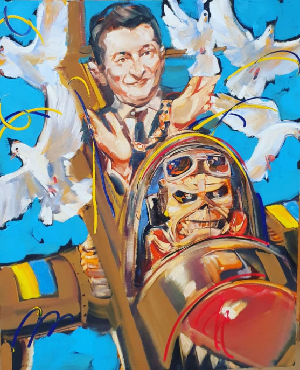
Птахи миру (The birds...
Watercolor on paper

At the breaking point of the worlds
I could not raise my head
Above the grass;
I saw too little, that’s too sad;
But much of knowledge “you” had passed.
He was born on May 25, 1950, in a prison cell. His mother was arrested along with other unreliable on suspicion of assisting the UIA (at that time almost half of his village was under the investigation). During the last month of pregnancy, she was kept in the dungeons of the Soviet punitive organs, where Praskovya Grinyavskaya gave birth to her son. Only after that, she, with her baby in her arms, was released to the village of Vovchuha, Gorodoksky district, Lviv region.
It is this settlement that is written on the birth certificate of Mikhail Andreevich. The baby got his mother’s last name since his parents hid their marriage from the Soviet authorities. At that time, the boy’s father had already been arrested and sent to Karlag, one of the largest Stalin camps in the USSR, where the political prisoners were held.
Deportation
The years have passed. The Mikhail Andreevich’s head became grey; he became the father and then grandfather long a time ago, but remembering the events of those years, the elderly man pauses to dash an unwelcome teardrоp away from his eyes.
My entire family, grandfathers, and great-grandfathers lived near Peremyshl. This border area was got passed around, but despite the change of power, Ukrainians lived there from time immemorial.
The maternal grandfather, Mikhail Grinyavsky, was a vijt (mayor), and also a local entrepreneur. Taking care of the order in the district, the community decided to open alcohol-free shop. Since such a store could not make a big profit, the only one who decided to make an alternative to the Jewish-korchmar (shop-keeper – transl.) was the volost’s head.
My father worked as a rural teacher, and my mother was a tailor. In her spare time, she participated in a rural theater: amateur actors staged “Nazar Stodolya” and other plays of Ukrainian authors very popular in Peremyshl in the 1930’s.
Subsequently, the father headed the Maslosojuz. In addition, in 1937, he was elected chairman of the local organization Prosvita, and after a year he became a member of the OUN. On behalf of the organization, he worked with the youth, organized training courses and training seminars, arranged performances, concerts, festivals; he was engaged in business matters. The OUN even sent him to the Lvov Trade School to get an economic education (at that time the border between Poland and Ukraine was open). From time to time, Andrey went home to see the family, and then again, bypassing the Polish and Soviet barriers, he made his way to Lvov. After the Germans occupation, the training ceased.
One of the most difficult memories of his father is connected with that period. In 1941 he helped pull out the corpses from the dungeons of the prison on Lontskaya street left after the retreat of Soviet troops. Leaving the city, the NKVD officers (People’s Commissariat of Internal Affairs) drove hundreds of prisoners into close cells, as a rule, they were representatives of the Ukrainian intelligentsia, professors, academicians, and welded metal doors tightly. People, who were buried alive, gasped without oxygen. The Bolsheviks put the blame for this punitive operation on the Germans who entered the city.

In the foreground - little Misha Grinyavsky with his brothers, grandmother, mom, aunts and uncles.
A few decades later, Mikhail Dmitrov created a sculpture in memory of these terrible events. Now this memorable sign can be seen in Stryjsky Park.
As for the Galicians, who were lucky enough to survive during the war, after the Nazis left, their troubles did not end. In 1944, the government of the Ukrainian SSR and the Polish Committee for National Liberation signed the “Agreement on the Mutual Exchange of People in Border Areas.”. It was envisaged that the relocation would be voluntary, but in fact it was carried out with the use of military force and very rapidly.
I wasn’t born yet, and my elder brother Miroslav was barely a year old. My mother told me about the armed Poles came into the house. Adults were ordered to sign a statement of “voluntary” departure, and when they didn’t agree, the soldiers threatened ‘In case of refusal, we will shoot all’. To confirm the seriousness of their intentions, one of the Poles pointed a carbine at little Miroslav. And he would have shot, but the second one prevented him.
Mom’s family was deported from Poland to the territory of the Ukrainian SSR in 1945, before the operation Vistula. They were kicked out, deprived of everything: eight hectares of land, a big house, stables, barns, and inventory. They were provided six hundred square meters of land in Vovchuha (village not far from Lvov).
A Horse for Denunciation
Mikhail Dmitrov’s father after his migration from Poland formally worked as the chief accountant of the resort “Bolshoy Ljubin”, but in fact, he was an underground worker and fulfilled the task of the UIA.
My father had many names. During the war, he acted under the pseudonyms Domnich and Dorosh, and after 1945 he was known as Litvin. In 1950, my father was arrested. Most likely, he was betrayed by his mother’s brother, a well-known robber who had plagued the Austro-Hungarian gendarmerie. Most of all, the uncle loved horses and missed the stallion that the Poles had taken away during the deportation. He was caught on this hook by Soviet Ministry of State Security’s officers who promised him to return his favorite horse for the denunciation. And it should be noted that in part they kept their word: after my father’s arrest, uncle did buy a horse, and besides, he became a senior groom in the collective farm stables.
But the informant only reported that my father had forged documents and used the fake name, but said nothing about his involvement in the Ukrainian national liberation movement. Perhaps he was afraid for his life because if the Ministry of State Security learned the truth, my father would be shot, and the whole family, including distant relatives, would be deported. And they did not touch anyone, only Andrey Dmitrov was sentenced to 15 years of Stalin’s camps.

Mikhail's father, Andrei Dmitrov, during his imprisonment. 1955
Two Sacks with Franko
I was born after my father’s arrest and saw him for the first time when I was a schoolboy already.
Andrey Dmitrov returned in the 1957th, four years after Stalin’s death, when a wave of the mass liberation of the Stalinist repression victims from the camps was rolling across the lands of the USSR.
Dad sent a letter saying that he was returning. On that day we went out to meet him. Thin, unshaven, he carried two linen sacks. I thought that there were gifts... And when my father came into the house, he shook 24 volumes of works by Ivan Franko out of the bags.
As Andrey Dmitrov told his son, when they were taken from Karaganda, they had to wait long for the change in Moscow. To pass the time, the “nationalists” were taken to “Dom Knigi”. It was the largest bookshop in the USSR, where everything that was published in the republics was collected. Like, see how the Union takes care of national minorities.
Father’s friends wrote him in the camp that it was impossible to buy Ivan Franko in Lvov. Therefore, the father took out money earned over seven years of exile and bought a complete collection of the works by the Great Kamenyar.
Since then, Mikhail has become a “librarian”: rural children often came to him for books. This collection is still kept in the house of Dmitrov. However, several volumes are missing: someone from the “subscribers” did not return them.
There is a Genius in Every Flock
His father, unintentionally, contributed to the first artistic attempts of his son. On Easter, he sent greeting cards from the camp. Looking at the drawings on postcards, little Misha began to understand that his thoughts and feelings can be conveyed in the manner of the image.
His first work was a copy of “Self-portrait” by Taras Shevchenko, then he painted his grandmother, and then landscapes appeared. Mostly these were watercolor and black and white graphics.
Our family has never had the artists: peasant children used to get mainly agricultural specialties. For example, my elder brother Miroslav became a carpenter, Ivan was an agronomist, and I was drawn to painting from childhood. Of course, they didn’t approve of my hobby at home (my grandmother said that in Austria all artists were beggars). But I had a different opinion and after finishing the eight-year school ran to Lvov. In the first half of the day I studied at the part-time school, that was in the Palace of Culture of Railway Workers (popularly known as “Rocks”), and after lunch, he studied at a children’s art studio.
Having comprehended the basics of graphic literacy, Mikhail Dmitrov entered the Ivan Trush Lvov School of Applied and Decorative Arts.
It was a special place. It was already a sign that the school was named after one of the first Ukrainian impressionists who was friends with Ivan Franko and Vasily Stefanik. I was lucky to find a cohort of brilliant teachers of the old European school, who was still working at the specialized school. In particular, they were Lvov sculptors Yakov Chaika, Dmitry Krvavich, Lyubomir Lesiuk, and Taras Dragan.
Despite the fact that in the Soviet period there were common standards of communist ideology and unified educational programs were approved, at our school, many subjects were taught in qualitatively new, progressive methods (later the school became a base for other art schools, in particular, in the field of industrial design).
In 1971, Mikhail Dmitrov graduated with honors from the school, brilliantly defending his diploma project, an entry sign to the city of Gorodok. But despite the fact that the architectural composition was positively evaluated by Dmitry Krvavich and other members of the State Examination Commission, this sign was never installed on the spot for a very simple reason.
I took three arrows as a basis, and they reminded one of the officials of the trident.
After the school, Dmitrov was drafted into the army, and after demobilization, he entered the Kiev State Art Institute. It is strange, but still, not everyone in his family believed in Mikhail’s talent.
The ticket to Kiev cost 17 rubles. Mom gave me 25, saying ‘Anyway, tomorrow you’ll be at home because nobody will take you there.’
But it turned out differently. After graduating from art school with honors, Dmitrov was given a referral to the Leningrad Art Academy as a “five percent student”. Although, he did not go to the city on the Neva.
I was more attracted by Kiev, especially because I’ve already finished the Lvov decorative school.
In theory, all art schools in the USSR taught students the same programs, but the teachers were very different: in Leningrad, they were refined academics, although, in Kiev, the teachers were Mikhail Lysenko, Vasily Borodai, and Ivan Makogon. They gravitated more towards the modern European style, although in the end, the system forced them to submit to the dogmas of socialist realism.
They were permitted to leave the country, they saw the world. Everyone, who had the opportunity and desire to go abroad, instead of earning money on Lenin and Stalin (their pictures and sculptures – transl.), had very interesting works. For example, Ivan Makogon worked in Greek and Italian styles, was an unrivaled master of relief...
Meanwhile, Mikhail Dmitrov, young and full of ambitious plans, arrived in Kiev. Outwardly, he made a kind of strange impression: neither priest nor an artist... The reason for this was a black silk shirt with a collar-stand, which his mother had sewed in the Galician manner. Once, she gave exactly the same shirt to her cousin, who was a monk and who was executed by the Bolsheviks in the 1939th.
The strange student was treated with alertness in the institute, although his artistic abilities were out of doubts.
At the age of 24, I already had six years of artistic experience; after all, my poster in 1967 took the third place at the All-Ukrainian competition for the protection of cultural monuments. But at the same time in the school I was more specialized in architecture. Since I was still undecided exactly what I wanted to become, I submitted all the works en masse: graphics, painting, and sculpture (although I was more interested in graphics).
The teacher, who was on duty at the admissions office that day, looking at my works, said ‘Mikhail, you don’t need graphics, you need sculpture. And the poster is probably just your luck.’
But hardly he’d immediately seen a sculptor in me. I think that on the contrary: an experienced teacher couldn’t help but notice that although I made sculptures, they were made in relief technique. As for the three-dimensional figures, I never tried to work in this direction. And the best way to weed out an entrant is to send him to a place where he can’t cope.
The Day X
At the department of sculpture, there were 24 applicants but only eight could be accepted. Many applicants were children of famous artists. Mikhail passed the exam together with the daughters of Yuri Ruban, Mikhail Dekermenji. While his mother worked as a seamstress, and his father was repressed...
Before the exam, the seals were torn off from the door of the audience and we were put inside. Very quickly, I realized that those seals were just for show. Not only did some of the applicants know the topic of the creative task, some of them got the ready-made elements of future sculptures hidden behind their bosom. But what do I care? The main thing is to understand how to build a frame. Half an hour later I figured out the “skeleton”, and during the remaining seven and a half hours, I was sculpting the dynamic figure of the tennis player. I passed the creative contest perfectly.
Komsomol Organizer of the Course
The student Dmitrov’s special subjects’ teachers were Vasily Borodai and Ivan Makogon.
It was a serious school and a great success to be a student of such masters of artistic modeling.
At the institute, Mikhail recommended himself a successful student and a promising sculptor. At the invitation of Borodai, he participated in the creation of the monument To the Founders of Kiev, created a number of his own compositions. For his academic successes, Dmitrov got a higher scholarship. He was even elected a Komsomol organizer of the course. At first glance, this kind of social activity might seem strange, but in fact, the guy did not hold the offense to the whole world. Despite the tragedy of his family, he always distinguished an indifferent state machine and those people who he had to meet on the path of life.
Today, Mikhail Andreevich recalls with warmth the Hero of the Soviet Union, the tankman Alexey Fofanov, whose bust he poured from bronze; and his teacher, a major of the Soviet army, chairman of the institute party organization Ivan Makogon; as well as numerous Komsomol members who visited the Museum of the History of the Troops of the Carpathian Military District, where Dmitrov worked during the service in the army.
However, Mikhail could not be an exemplary activist. In particular, his career as an editor of the institute’s wall newspaperended with a lightning speed; the newspaper was removed, as soon as Dmitrov had hung it.
I was lucky: I knew slightly more than other students about Aleksandr Arkhipenko and Vasily Kandinsky. So I wrote about them, and then the newspaper was immediately removed from the wall, arguing that one of the students needed a wooden shield that served as a basis. Although in fact, such an excuse was very airy-fairy, because there have always been enough shields in the art institute. But all this fuss wasn’t worth the attention. The only thing I regret is I was never returned the original photos, which I pasted as illustrations.
The Libel
The position of Komsomol organizer wasn’t occupied by Dmitrov for a long either. As Mikhail Andreevich admits, ‘I was burned by singing’.
In 1975, according to the student exchange program, a Slovak delegation arrived at our institute. I was appointed the head of the group from our, the Ukrainian side. With those Slovaks, I learned the “Song of Dovbush”. But it’s not difficult to guess that among our students, as well as among the Slovak students, there were guys who informed “right people” about each our step. Most likely, they also reported to the special forces about our “singing lessons”.
Subsequently, there was another, more serious incident, and without the patronage of Ivan Makogon Mikhail would not have graduated from the institute.
In 1978, a group of young people, including in addition to Dmitrov Vasily Gerasimyuk, Vasily Portyak, Kirill Stetsenko, Taras Melnik, Vladimir Zubitsky, was accused of nationalistic activity. Although their “subversive work” was nothing more but collecting the folklore on cities and villages of Ukraine during summer holidays.
For the sake of this, I, actually, became a Komsomol organizer. We organized a group of students from the art universities to study national traditions: we collected songs, works of folk masters, etc. And the Komsomol financed this project. Moreover, we had an official appeal of the Kiev party organization to the leaders of three regions, Lvov, Ternopol, and Ivano-Frankovsk, about the promotion and assistance. That is, when we came to a small town, we were allocated a room in a hostel, club or school, where we spent the night.

On the grave of Taras Shevchenko, city of Kaniv. Mikhail Dmitrov - in the first row in the center, to the right of it - Taras Melnik, on the right - Bogdan Gulchy. The extreme left in the second row is Vladimir Zubitsky.
Young people never found out who reported to them in the KGB, but all the members of the group were under investigation. Mikhail had stayed in the cell for 15 days.
As a result, some of the guys were expelled from their universities, and I was defended by Ivan Vasilyevich Makogon. He promised to publicly withdraw from the ranks of the CPSU if the case takes such a turn.
Subsequently, the authorities would remember Mikhail this story many times, but for that time, the student of the last year of the art institute was supposed to “sculpt a diploma”.
24 Volumes by Lenin for the “Erotica”
Mikhail naively believed that with regard to his graduate work, no one would have any questions, at least from an ideological point of view. The project of the sculptural group, presented to the pre-diploma commission, had already won the first place in the art competition held by the Kiev Regional Committee of the Lenin Communist League of Ukrainian Youth.
The sculpture was called “Desna Flows into the Dnepr”. From the hands of the girl (Desna) water flowed into the palm of the young man (Dnepr) and fell into the reach. It was a lyrical, far-from-politics composition that did not evoke associations with either a trident or any other undesirable element in Soviet ideology. A bronze fountain was planned to be installed near the cafe “Cuckoo”, across the street from the district committee of the Komsomol.
As a result of the competition, I was given the first prize with the prospect of installing the facility on site. And the prize was a collection of Lenin’s works in 24 volumes. I couldn’t figure out what I should do with such a pile of books I didn’t need. Finally, in the district committee of the Komsomol, they advised me to give them to the library of the plant “Leninskaya Kuznitsa”. That’s what I did.
But another thing was important: the Ministry of Culture allocated funds for materials for sculpture and I came close to its embodiment in bronze. But unexpectedly the project was “stabbed” by the pre-graduation commission. During its meeting, Professor Lopukhov said ‘This is a bourgeois culture. Look what he’s done; he’s stripped a boy and a girl right in front of us’.
I have no idea how Alexander Pavlovich could see eroticism in the mystery of waves, water, and abstract human images, but the rector’s opinion made no objections.
My creative supervisor Vasily Borodai advised ‘Urgently seek a new topic. For three months you will approve the sketch, and for the remaining four you will sculpt the diploma’.
My idea was ‘The Mermaid of the Dniester’. But Vasily Zakharovich looked at me intently ‘Do you still want?’ and we both realized what he meant.
The last option, which my heart was in, was a monument to Vasily Stefanyk.
Deathless Prose on the Wrapper
While working on the sketches of the future sculpture, Mikhail Dmitrov decided to go to Rusov, Stefanik’s homeland, during his summer holidays. He was encouraged by his creative supervisor Vasily Borodai, who previously worked in the Ivano-Frankovsk region and personally acquainted with the son of Vasily Stefanyk, Kirill.
I didn’t even have my own camera, so I went off together with Petr Krishtalovich, who studied for the cameraman at the Karpenko-Kary Theater Institute and was able to take a movie camera there.
We went to Lvov by train. At one of the railway stations, Petr bought some sausage. The saleswoman wrapped it in a gray wrapping paper (older people remember that it was universal and the only packaging in the Soviet retail trade).
When we decided to have dinner, I began to draw a sketch of the monument just on the edge of the wrapper. And when I finished, I tore off the piece of it with the picture and put it in my notebook.
After his return to Kiev, Mikhail Dmitrov showed dozens of prepared sketches to the creative supervisor and his assistants, but Borodai liked none of them.
I see he’s not satisfied. ‘It’s not that, Mikhail, not that’, he says. ‘It’s all corny, there’s no Stefanyk’s spirit, his essence of his novel, drama...’
But Borodai’s assistant drew attention to a gray, ugly scrap of paper, which I didn’t even dare to show the academician. Vasily Zakharovich beamed ‘This is what you need! Start sculpting right tomorrow’.

Sketch of a monument to Vasily Stefanik on wrapping paper.
“Stefanyk” at Your Own Expense
His diploma project Mikhail Dmitrov defended with honors. Moreover, the project of the monument got a positive evaluation at the All-Ukrainian art competition, and the sculpture itself was to be installed in the village of Rusov at the state expense. This decision was made by the state commission, which included academicians Mikhail Deregus, Vasily Borodai and other well-known Ukrainian artists. But, as it turned out, not their decision was critical, but the personal opinion of ministerial officials, who were given the right to judge and pardon.
One of such penpushers asked me ‘Who is he, your Vasily Stefanyk? Nationalist, I guess.
‘No,’ I answer, ‘he’s the Ukrainian writer included in the school curriculum.’
‘Well, whatever. If he was a prominent party figure or, say, a war hero, then another thing...’
In short, the construction of the monument was not forbidden, but they refused to finance it. If there is a desire, I can install at my own expense. As the official said ‘Put it in your garden.’
Just a little more, and the idea of graduate Dmitrov would be completely lost: a month passed, the clay cast was already beginning to fall apart, and Mikhail had no money for a plaster cast. But, as they say, there was some luck in this misfortune.
I had to go on a student exchange program in Slovakia, in Bratislava University of Fine Arts. My mother had already sold the bull in order to save money for my road expenses. However, I wasn’t given a permission to go abroad (they recalled the “Song about Dovbush”). Of course, it was a shame, but for the 300 rubles sent by my mother, I cast Stefanyk in a plaster.
The statue stood in the studio of the art institute for a long time, while Mikhail was not warned ‘We give you a week, if you don’t take it, we’ll take it to the dump’.
Valentin Ivanovich Znoba let Stefanyk and me in his cellar; and soon Borodai acquainted me with Vasily Stefanyk’s nephew Luka Yurevich Stefanyk, who had previously headed the collective farm named after Stefanyk in the village of Yaseniv. At the time of our acquaintance, he had already handed over the reins of the government to twice Hero of Socialist Labor P.I. Sokur. Luka Stefanyk held a leading position in the Gorodenkovsky district and, in combination, was a deputy of the Supreme Soviet of the Ukrainian SSR.
The deputy liked the sculpture, and he acquainted Mikhail Dmitrov with his cousin Semyon Stefanyk, the son of the writer.
We went to Yaseniv with Semyon Vasilyevich. In order to save money, the monument was decided to make of forged copper instead of bronze. We decided on the place; it should be near the office of the local economy. However, there was already a sculpture of a deer and a tattered bust of Vladimir Lenin, but the chairman of the collective farm P.I. Sokur promised ‘We’ll remove the dog-headed (this is how they called Lenin in the Ivano-Frankovsk region) and put Stefanyk. However, the regional authorities didn’t allow dismantling the bust of the leader, so they had to move the deer farther beneath fir-tree.
But unfortunately, during the Soviet regime, the classic of Ukrainian literature was not particularly honored and the same attitude is still kept.
I recently visited Yaseniv. Stefanyk bent down, almost fell, half of his leg is torn off. I turned to the local authorities, called, but there wasn’t any reaction at all...
“We Do not Need Such People Here”
After graduating from the university, Dmitrov was sent to work as a teacher in Kosov. But there he was refused, saying that they did not want to have a “nationalist” in their staff.
Then he was given a referral to the Kiev agency “Telepresreklama” by Valentin Borisenko, who at that time headed the Lvov Institute of Applied and Decorative Arts. By the way, an interesting detail: the sculptor Borisenko is the co-author of that bust of Lenin in the village of Yaseniv, which should be “moved” to put a monument to Vasily Stefanyk, made by Dmitrov. This is the poetic justice.
In “Telepresreklama” Mikhail Andreevich was to mold mannequins, which were then cast from plexiglass. He had worked there for six months until it turned out that in the basement of this agency there was an illegal workshop for making sculptures. When the police exposed the criminals, the main tricksters disappeared abroad, and the young artist Mikhail Dmitrov, who had no idea about the clandestine factory, was advised by one of his older colleagues to write a letter of resignation before it was too late.
However, the story did not end there. Mikhail was reminded of his participation in the so-called “nationalist group”, which was “exposed” by the KGB, and the relevant authorities asked the young artist to leave Kiev within 24 hours.
Dana
In August 1977, Dana came to Mikhail, and a few months later they got married. Remembering the story of their love Mikhail Andreevich smiles.
We grew up in the same village; we used to graze the cows together. One day, playing, I threw a frog under her shirt, and she stole my heart.
Having graduated from the Lvov Pedagogical School with honors, Dana had the opportunity to choose where to go to work. She decided to go to Kiev, knowing that her fiance cannot imagine himself away from the capital.
In Fastovsky district department of education, she was offered to choose work in Veprik, Belky or Malaya Snitynka. They decided to settle in Malaya Snitynka because its uneven relief reminded native Lvov region.
The young couple was allocated a nine-meter room in a rural hostel. Over time, their daughters Miroslava and Oksana were born.

New Year's Concert in the office of the State Farm with. Small Snitinka. Singing Michael and Dana Dmitrov.
Not deserved because not served
Dana got a job as a teacher in a kindergarten, and Mikhail was actually unemployed. He wasn’t accepted in the capital’s art factory without a Kyiv residence. He also wasn’t accepted by the Artists’ Union of the USSR...
In the forms, there was the line ‘Where were the parents from 1941 to 1945?’ I wrote ‘They were repressed, Operation Vistula.’ After that, I wasn’t accepted into the Union for 10 years more, and only at the time of Gorbachev’s perestroika, they approved me. Two years later, instead of a booklet with the USSR coat of arms, I was given the certificate of a member of the National Union of Artists of Ukraine.
Thus, in the early 1980’s, Mikhail Dmitrov, winner and prize-winner of several Ukrainian art competitions, instead of active creative work, had to work for three years in a greenhouse rented at a local state farm. Dana and he barely made the ends meet.

Mikhail Dmitrov (left) and Vasily Gerasimyuk return after watering the greenhouses of the local state farm.
The tomatoes have already begun to ripen. We were going to buy a TV or a fridge for the money we got. But one morning I found the greenhouse empty: at night someone took out the whole harvest. We knew who the thief was, but could do nothing...
Desperate, Mikhail went to the construction team. For five years he had been working as a painter until he got lucky: Dmitrov managed to take a position of a part-time drawing teacher in junior classes. However, a few years later he was urged to write a letter of resignation.
Though, times had changed, as had the political situation in the country. The negative attitude towards “Bandera supporters”, “nationalists” and other politically unreliable elements became not so categorical. In the late 1980’s Mikhail Dmitrov did manage to get a job in an art factory. Although there were almost no orders.
I was given work only when others refused it (basically, these were sculptural groups that required complex compositional solutions). But, by and large, I am grateful for this to my former bosses because at that time the orders for images of leaders were the most in demand; their busts always went with a bang and were paid for well. In this respect I was lucky: during the whole my life I never molded any Lenin’s or other “great helmsman’s” bust.
To realize himself as an artist, Dmitrov went to Moldova at the invitation of an old friend, the head of a large agricultural enterprise. And the first work, a monument to soldiers-liberators, brought Mikhail Dmitrov fame and many new orders in the territory of Moldova74. Monumental and easel sculptures appeared one by one from under the hand of the master. This not only brought moral satisfaction but also strengthened the material position of the artist. However, the sculptor was tormented with painful longing for his homeland; so he returned to Ukraine.
In 1993, Mikhail Andreevich, keen on the idea of the revival and development of Ukrainian culture, headed the local branch of Prosvita, and also founded the first museum of national studies at the Malosnitynskaya secondary school and in the same year opened the children’s art studio “Kamenyar”. He worked a lot and fruitfully, however, as before, the artist did not have the opportunity to fully develop his own creative potential, and, materially, the situation left much to be desired.

The first congress of the intelligentsia Fastova. In the center is a Ukrainian singer, People’s Artist of Ukraine Nina Matvienko. 1993 year.
In 2000, the artist, not in demand in Ukraine, was invited to work with the Vienna Academy of Saint Margarita.
They set the task very clearly, and when I tried to make something of my own, they said ‘We invited you not to make your Russian goddesses here, but to restore our traditions’.
Mikhail Dmitrov returned to his Homeland in 2006. The experience gained while working in Austria, the artist now realizes in Ukraine. And subsequently, with the commercial orders, Dmitrov develops social projects, which he calls his tithe in the development of the Ukrainian state.
Is it a Curse or Blessing?
Today Mikhail Andreevich is a successful artist and a personality well-known in the Fastovskiy district. He is a happy husband, father, and grandfather.
I was lucky for good people as well as bad people on the way. However, I didn’t get any regalia, but what I can do with my “roots”. I think that I could have done much more unless my “family karma”. But on the other hand, I could have made many mistakes; at least I can say I managed to remain honest with myself.

Mikhail Dmitrov in his studio.
Leave a comment
Related posts
-
 Alexander Vygovsky’s Unformat
"When I was ten, I played football. When he was twenty, he studied at the university to become an engineer. When he...
Alexander Vygovsky’s Unformat
"When I was ten, I played football. When he was twenty, he studied at the university to become an engineer. When he... -
In Search of Lost Dreams
In the paintings of Goryany, we observe an alchemical process, as a result of which cosmic energy, concentrated in...
-
Blue Blush by Sasha Bob
The first thing that catches your eye is the apparent simplicity, deliberate negligence and that extraordinary...
-
Song of Protest by Peter Yemts
In the late 1980’s, journalists called Petr Yemets a stalker of the Chernobyl zone, a guide who leads people to an...
-
Any Painting is a Drawing of Yourself
In Kristina Smelova’s painting, the impressionist methods are clearly visible. Working mostly with the palette knife,...
Latest comments